Monday, 6 August 2018

It all starts with a smile

By Ksenia Rossinkaya 
I am a 34-year-old mother of two beautiful children; Arina is 5 and Miron 3. I live in Moscow and strive each day to improve my life by becoming better than what I had been the day before, both in relation to the world around me and within myself. I am learning to live life based on the principles of positivity, kindness and of nature’s beauty. This is not always an easy path and requires me to constantly work on myself. 

I used to be a project manager before the birth of my children. I was in charge of the construction of a pipeline in the United Arab Emirates. It was a huge project valued at approximately 417 million dollars. Later I became involved in the organisation of one of the largest and most successful University Games in Russia, held in Kazan, being responsible for the opening and closing ceremonies in the summer of 2013. After the birth of my daughter of Arina, I moved into a private venture: I acquired the House of Beauty Granual and have remained its owner for the past 3 years. 

It was Granual that offered me the right environment and created the context that forced me to make changes to my personality. I had to work with and manage a group of employees, 90% of whom were women that required a depth of understanding of human nature and reactions; I became aware how effective a smile could be, the magic key that seemed to open all doors!     

My story of change, however, began more than 10 years ago. It was a beautiful English summer and I was trying to raise the level of my English at a British school in Folkestone, Kent. One afternoon, during break, my friend Angela Garcia who was Spanish and I sat chatting when our favourite tutor walked into the room and asked how we were doing. 


My friends in the British school
On a summer's day in Kent
  Angela, in her own inimical manner, responded looking joyous, ‘I am fine.’ Unaware of any implications and not thinking too much about it, I simply repeated what my friend said. But our tutor asked me to my surprise: Why do you always say that you are all right with an intonation and an expression that does not reflect your true state of mind. His remarks got me thinking and what dawned on me, became the turning point of my life.                                                                   
I began to deliberate on the theme of smiles on people's faces, to analyse the behavioural factors that induce smiles and their influence. And I came upon an interesting discovery. After all, a smile was nothing more than the movement of muscles on a person's face; it can be cultivated as a habit like any other, for example, one’s posture. You get used to keeping your back straight till it becomes natural. Similarly, with a smile. 
In London, my favourite city


I then began to practise. Every day 3 times for 10 minutes I worked on the habit of smiling- a perfect Hollywood smile! At first the smile was like a grin, but I kept at it and did not stop. Day after day, I smiled, smiled, smiled! After a while, the muscles of my face got used to a big smile, and the face looked different-more positive as the smile became a natural part of me! I found faces of people on the streets lighting up  as they reciprocated to my smiles. It was very encouraging to observe how something like a grey veil disappear and the faces of passers-by dissolve into sparkling smiles. Everything suddenly turns brighter and more beautiful! 
The radiant smile

It's been more than a year and a half since the moment when smiling has become an integral part of my life! I try to smile always, in all situations. And when something happens to spoil my mood, I first look at the situation with a smile and sympathy, and then I start to analyse it and find a solution. Being in the right frame of mind makes 50% of my tasks easy to accomplish.                                                                                                                            

A smile, like light, softens our facial expressions and gives it radiance; it makes us happy every day, day after day. I have so often found a smile melting hearts and bringing upon the brightest and kindest expressions in others. 


My mantra therefore is always smile more and life will transform for the best.

Tuesday, 17 July 2018

A joyous day and some poignant memories

By Pragati Tipnis

9th May, the Victory Day, is celebrated on a grand scale in Russia. The document ending the Second World War, the German Instrument of surrender, was signed in Berlin late in the evening of 8th May 1945. In Moscow, the clocks had marched on to a new day at the time of signing of this historic document; thus here they celebrate this day of historical importance on the 9th of May. It is, of course, a happy day for all Russians, and many festivities are organised throughout the country. The day in Moscow starts with the Military Parade on the Red Square, where the country displays its latest war technology. The President in his address to the country pays tribute to those who died fighting fascism. The whole nation maintains a minute’s silence to pay homage to all the known and unknown soldiers, whose bravery and sacrifice gave the world a peaceful sky to live under.
Celebrations this year at Red Sqauare

For the last four years, a march called, Immortal Regiment March, is organised in Moscow. 
People with pictures of loved ones

The number of participants in this parade has been increasing every year. According to estimates, this year more than one million people participated in the procession. Moscowites come carrying placards with photos of their family members in this march. The number of participants and photos they hold can give but a rough estimate of the losses every Russian family underwent in the war.

This year I also went for the Immortal Regiment March with two Russian families. My friends were carrying photos of their closest relatives lost during the war. We joined this procession from Belorusskaya Metro station and walked up to the Red Square, the endpoint. Walking in long strides with the Russians and people of all the former Soviet republics now living in Moscow, was indeed a unique experience.

Joining the celebrations
The whole crowd was singing songs of the Great Patriotic War. Lyrics of those soulful songs made me tearful, several times. In one of the songs, it says that this day is a joyful one though it brings tears to the eyes. The festivities and celebrations cannot wipe out sorrows and losses of the war years. 
Though the distance covered by the procession was not much, strolling singing songs and crying out patriotic slogans took us around three hours to reach the Red Square. Upon arriving the Red Square, we clicked a few photos and headed towards the closest metro station Tretyakovskaya. 

Lena had invited all of us for dinner after the parade. She had cooked half the things before leaving for the march and the rest we all quickly prepared after we reached her home. Of course, by this time all of us were very tired and hungry. After we had settled down with the first round of food and drinks and all of us were feeling a bit relaxed, passionate toasts and tales of the war started pouring in. As I have mentioned in the beginning, there were two Russian families present at the table.  
With Lena

My  friend Lena, who was the host, is from Saint Petersburg, which was known as Leningrad in the Soviet time. Leningrad was under siege by Nazi soldiers for close to 900 days. Located in the north of Moscow and situated on river Neva, at the head of the Gulf of Finland on the Baltic Sea, the city becomes extremely cold during winters and temperature drops below minus 20-degree centigrade for several days.


This war has had a very big impact on the people of Soviet Union, especially in the European parts, where the war had reached the doorsteps of ordinary citizens. In our first year of studies in Tbilisi, when we were undergoing Russian language course, we were taught about the Great Patriotic War in details. We had learnt that the siege had cut off the people of Leningrad from the rest of the country, and for almost three years they had to live on inadequately rationed food. Apart from the usual war hostilities, the cold and hunger too took their toll on the situation, and the people of the city kept dying and families losing their members.

The other family at the table was from Moscow, and they also had many stories of courage and loss to share. Of course, the war had adverse effects on the whole country, but several of the cities were very severely affected. These cities, after the war ended, were honoured with Hero-city’s title for their outstanding heroism. There are 12 such cities, and Moscow was one of them.

These tales are very precious and rare, as the older generation who had lived through the war years were not too keen on talking about those dark and haunting days. My friends have painstakingly gathered all available pieces of information and tied them into tales.

Lena comes from a family of army officers. Her parents and grand parents served the Soviet army throughout their lives. Lena’s grandmother, Lyudmila Michaelovna Gerasimova,
Lena's  grandmother, Lyudmila
worked in the army hospitals from the age of 18. She started her job as a nurse in field hospitals during the Finland war of 1939. Later, during the World War II, she served in Hospital no. 2015 in Leningrad throughout the siege in the capacity of army personnel as a Lieutenant. In 1941, she gave birth to a girl, when her husband was serving somewhere near Leningrad. In January 1942, nobody could trace her husband, and he was enlisted ‘missing.’ Her daughter of 6 months died of cold and hunger in January 1942. The fate had more punishments in store for Lena’s grandmother. Her father, who because of poor vision was not allowed to go to the front, was at that time working in a factory. One day while returning home from work a bomb fell on him and he died on the spot. Some people saw this mishap and informed his wife about his demise. She had a weak heart and too passed away after two days of the incident, unable to bear the painful blow.
Medals won by Lyudmila

It is beyond me to imagine the trauma that a 21-year-old girl had had to undergo in those dark days of January 1942. Within the space of 15-20 days, she had lost her parents, husband and the only child. Because of the siege, people at that time were buried in mass graves and till date, Lena’s family does not know where the final resting places of their close relatives are. Apart from these misfortunes, Lena’s grandmother lost her aunts and uncles too. She could live through those dark years thanks to her young age and her army hospital job. People working in war connected areas were given more rationed food than what the civilians received. The grandmother received 400 grams of bread, instead of 125 grams given to other civilians. For her services towards the country, she was awarded many medals and laurels. She was decorated with the Order of the Great Patriotic War, medal for the Liberation of Leningrad, Zhukov’s medal, Citizen of Leningrad during siege and many more. Now, these decorations are articles of pride for the family. There are stories that hunger was so bad in Leningrad that all dogs, cats and rats had begun to disappear. At times even people were found missing.

Vasily Pankov
The other family at the table was Anna’s. Anna’s grandfather, Vasily Pankov, was a Lance Sergeant in the Soviet army. At the time of his death he was 18 years old. He joined the army in January 1943 and died fighting the enemy in June 1944. In a battle near Dneiper in Belarus on 28 June 1944, he killed 11 German soldiers in direct combat. This heroic deed helped their regiment block an apartment building and capture 100 German soldiers barracked there. Later on the same day, he and his regiment fought several fierce battles on the street of the city of Mogilyov and killed around 60 enemy soldiers. He died fighting in one of those battles. For his bravery and heroism he was honoured with the highest award of the Soviet Union- Hero of the Soviet Union. Anna says that though he served in the army for a very short period, his many awards decorate their house. He was honoured with the order of Lenin, the Order of Glory, and the Military Merit Medal. He was awarded all these medals posthumously. 

After joining the army Vasily had been injured three times seriously. And every time he would run away from the hospital to the front, before getting fully cured. Anna believes that he must have inherited this trait of being headstrong and fearless from his mother. In 1941, Vasily was visiting Odessa to spend his summer vacation with his cousins. The war started on the 22nd of June. The place he was staying was one of the first to go under German occupation. When his mother came to know about the occupation, without giving a second thought, she headed there to bring her son back. Her journey from home to her son was not an easy one. As she got closer to Odessa, things kept getting worse. She had to go through many check-points, change trains several time, and answer questions of the occupiers. But none of these could deter her from her mission of locating her son and taking him back home. Of course, this was just the beginning of the war in the USSR, and the things had not yet become very bad. She succeeded in finding her son and both of them could leave the occupied territory and return home. After returning home, her son stayed with the family for a very short period. He joined the army and left for the front in January 1943 to die in June 1944.

We continued talking about war days’ stories and many other things sitting at the table, when the sky and certain buildings started reflecting bright colours. The Victory Day fireworks had started at 10 in the evening. We went out to the balcony and enjoyed a tiny fraction of the spectacular fireworks displays organised at several points in Moscow. While enjoying the dazzling exhibition, I was thinking what the few remaining veterans of the war feel looking at this spectacular show. I feel along with the jubilant feeling of victory, they experience deep sorrow of great loss at such moments. These veterans don’t want the world to go through any more wars. Festivities of victory are celebrations of peace and peace alone.


Pragati Tipnis lives in Moscow


Monday, 9 July 2018

Your name is written on every grain you eat

By Irina Maximenko

I love India and I love Indian food and can cook quite a few popular dishes like daal, shahi paneer, palak paneer, chicken curry, tandoori chicken.

I was first introduced to Indian food in the home of Shahida Zaidi in Moscow. Shahida who belonged to the family of the famous poet, Altaf Hussain Hali, was a senior broadcaster in the Moscow radio. She helped me with my Urdu, taught me the finer nuances of Urdu literature and how to pronounce several words perfectly. 

I had graduated with a Master’s degree in Urdu from the Moscow State University and joined the Moscow Radio. Shahida invited me to her house where I met Ranjit Basu, her husband and a senior broadcaster too and tasted Indian cuisine for the first time and loved it. This was before my first visit to India in the autumn of 1967, the same year. I spent several months in India to improve upon my language skill.
Shahida on the left and others

It was in Lucknow, one evening at a reception held in the Rotary Club where an elaborate buffet was laid out[1]. I knew I would love the food because I had tasted Indian cuisine in Shahida’s home and therefore piled my rather large plate generously with all that was on offer. I put a spoonful in my mouth and the intensity of the spices struck me and I froze. I could neither swallow nor spew the food out; the experience of Shahida’s delicate cooking was clearly not enough to prepare me for this onslaught. An elderly Indian gentleman saw me and understood my predicament. He came up to me and asked me to keep still. He returned with half a lemon and asked me to open my mouth and as I did so, he squeezed the juice inside. I felt my breath back. His words of advice were that I must never take water or tea with hot spicy Indian food. It must always be a squeeze of lemon!

However, I never had a repeat of this experience because I was wiser; I always tasted a small morsel before tucking into large portions and also found tomatoes to work well. 

I travelled to India 11 times, in which on two occasions stayed for 8 months. I visited Pakistan 4 times and travelled extensively, staying in homes of local residents, in villages and cities. I found Pakistani cuisine comprising more of meat dishes than vegetables. Otherwise the food is quite like what I had eaten in India. They make similar daal, samosas and of course biryani that is everywhere[2]. What follows is a biryani tale.

Once I was invited to a conference in New Delhi organised by the Progressive Writers of India in the late 1980s. I made all the necessary arrangements, secured permissions, visa and ticket. A couple of days before I was to leave, I received a call from Kamar Rais, a famous Urdu scholar who I had met in Tashkent. He called to inform me that the conference had been postponed by a week. I was in a quandary and rushed to the administrative officer in the Moscow Radio for advice. He asked me if I knew anyone with whom I could stay in Delhi for a week. Shahida and Ranjit by then had moved back to India and lived in New Delhi and I knew I could always stay with them. So, I told the officer that I did indeed have a home to stay in. He said then just go and I did!

As soon as I got to Delhi, Shahida told me that the well-known Urdu writer, Jelani Banu and her husband Anwar Moazzam, the famous scholar who lived in Hyderabad in southern India had called several times asking for me[3]. Anwar had a special name for me. He called me Karishma Khatoon. We were introduced not too long ago in Moscow where I had been their interpreter. He and Jelani were making a TV serial called Pyar ki Manzilen (Destinations of Love) in which there was an episode involving foreign scholars participating in a Round Table Conference. They found a Russian teacher from Osmania University in Hyderabad but when they got to know that I was visiting India, they wanted me in the serial.

 Jelani sitting in the centre, Anwar on my right
I agreed to travel to Hyderabad since I still had a week before the conference was to begin. But the problem was getting an air ticket to Hyderabad in short notice. It was very expensive for me to buy as a foreigner. Intervention at the highest level of the Indian government followed and with the special permission from none other than the Prime Minister of India, I.K.Gujral, I was offered a ticket at the local rate that my hosts in Hyderabad paid for. My stay and the TV shooting went off very well and it was time for me to return to Delhi. Jelani was, however, a little unhappy because she wanted me to visit her brother who I had met in Moscow. He was a well-known Physicist and according to his doting sister, was also celebrated for making the best biryani in Hyderabad. Unfortunately, I couldn’t make time and instead of taking me to his uncle’s place, Farhan, Jelani’s son had to drive me to the airport not before feeding me to idlis that I just love[4].


At the airport, while I waited it was announced that the flight I was to be on, had been cancelled. I panicked and rushed to the counter, showed my ticket and the invitation to the conference and said that I needed to be in Delhi that night. The person at the counter very kindly accommodated me on the later flight that was to leave at 7 in the evening. That gave me a few extra hours in Hyderabad. But I didn’t know how to reach Farhan and Jelani. I came out of the airport to the car park and found that they were still there. Jelani was ecstatic. She called her brother that we were coming to have biryani and we dashed off! I had the unforgettable experience of the most delectable biryani I had ever had. This was only made possible because of the delay in the flight. I was reminded of the Urdu saying: ‘Your name is written on every grain you eat.’[5] So, I was destined to eat biryani that afternoon, after all!


Irina Maximenko lives in Moscow


[1] Lucknow, a city in North India which is also the capital of the province, Uttar Pradesh. 

[2] Daal is made of various kinds of pulses, cooked like a soup; samosa is a snack of savoury filled patty; biryani is rice and meat cooked together with spices.

[3] Hyderabad, more than 1500 km south of the Indian capital New Delhi, is at present the capital of Telangana.

[4] Steamed, savoury rice cake.

[5] An Urdu saying that is applicable to life and human destiny as well, as Anwar explained to the author.

Wednesday, 27 June 2018

The Life and Times of Vassily K

Sergei K. in conversation with Tapti Roy

Thinking about the life and destiny of my dear Grandfather Vassily, I have come to the conclusion that his life is best defined in the words of Sheila Fitzpatrick in one of her studies about Russia, as an ‘ordinary life in extraordinary times.’ 

The reason I sit down to write about my Granddad is because he had looked after our family through the most challenging of times overcoming dramatic obstacles that marked the situation in Russia between the years 1920 and 1960. Vassily not only survived but thrived as did his children and their families by the dint of his intelligence and pluck. 

Vassily Pavlovich K. was born in 1896 in a small village near Saratov city (the area of middle Volga River) in a place where his ancestors lived for centuries. That land has a great history: in the middle ages, it was occupied by theGolden Horde and after their power declined, Russian peasants migrated and established settlements, some of which still exist today[1]

Vassily attended a primary school run by the parish church and received very good education (I remember Granddad explaining me when I was very young, the principles of four-stroke engine – after more than 50 years he remembered every details). By the time Vassily turned 11, he had already trained as a hammersmith and later while working in the village obtained skills in joinery, carpentry and in caring for horses. 

In 1913, when Vassily reached 17, he was recruited to one of the reserve regiments of the Tsarist army in Saratov city which was had turned into a regional centre with a large garrison (around 60 thousand service men compared to 242 thousand of townspeople). Due to his experience and expertise, Vassily was appointed in the cavalry regiment. 

The service of young cavalryman was terminated suddenly in February 1917 when the last Russian Tsar Nikolai II was forced to abdicate. When this was happened, all of Russia experienced a great political shock. The way the course of events of February and October Revolutions unfolded in a province town is very clearly described in the study of Donald J. Raleigh.[2] For some time, there was total chaos! 

Within a year the Russian Empire fell with no single political party to take any decision or be responsible for the future of the country: none but the Bolsheviks led by Vladimir Lenin. Why did most of the population within the Russian Empire support the Bolsheviks? The answer to such an important question can be found in the study of Alexander Rabinowitch.[3]

Vassily, a young cavalryman had already served for four years when Tsarist army was disbanded in 1917. He was faced with a choice: to join the White Army and support the previous regime that had been unfair to the majority of people in Russia or to fight for a new and better life promised by Vladimir Lenin and the Bolsheviks in October 1917. 

My Granddad didn’t think too much of this dramatic situation. Born in poverty and without a chance for a better life if Tsarist regime were to be reinstated and inspired by the new political change and challenges, he signed up for the Red Army and fought in the Civil War that waged between 1918 and 1921. He often told me that this war was largely prompted by Western powers who supported the leaders of White Army. Vassily once again was inducted into the cavalry. 

By the end of 1921, all major battles within the Soviet Union were over and the Government decided to reduce the number of military men (till 1920 the strength of the Red Army was over 5 million). Vassily’s regiment was relocated to Kursk where he met a young woman Evdokia (she was born in 1900)[4]. ‘The Fate moved the pieces on the Big Chessboard of Life,’ - soon after Vassiliy’s resignation, the young couple married. 


Young bride Evdokia
Newly wed Vassily in 1922

While researching the lives of Vassily and Evdokia, I applied to the regional archives at Kursk and got lucky when the archivist sent me Evdokia’s genealogical tree. The first record about her family dates to 1675 when her ancestor (surprisingly his name was also Vassily) came to the south of Russia as a “state peasant” – who was different from the “krepostnye krestyane,” a special type of peasants in Tsarists Russia[5]

Alexander and Tatyana 
Life turned hard in the early Soviet days and my Granddad Vassily, had to employ all his ingenuity to survive. In the period, 1922 to 1930, he with his family had to undertake many travels across southern and western Russia in search of a job. The economy in the country was in deep depression and it was extremely hard to get a reasonable position. The situation was further complicated by crop failures and widespread hunger. In 1924, their first child Tatyana was born and in 1925, a son, Alexander. 

In 1929 was born their second son and my father Vladimir. Due to frequent travels of the family Vladimir lived separately with Evdokia’s parents in the Kursk region until 1938. 


In 1930, my Granddad found a long-term position as a carpenter’s foreman at a coal mine in the Donetsk region[6]. It offered a good salary that gave him the chance to send his children to the local elementary school and to rent a space for living as well. His wife Evdokia also found a job as a cook (she was really a good cook – I do remember this from my childhood). 


In 1931, Vassily was recommended by the local Bolshevik’s organisation in Donetsk to be a member of the Communist Party and this membership opened up for him new opportunities. The Soviet state had a very sophisticated system of recruiting candidates for different responsible jobs spread all across the large country. Under Stalin, a thorough background check was undertaken before anyone was inducted into the Communist Party and this was repeated at later stages of careers. Upon being accepted into the party, and working for the next 6 years in Donetsk, Vassily in 1937 was sent to an Agricultural College where he earned a Diploma. That year his wife Evdokia and 3 children moved back to live in Kursk. In 1938, Vassily was assigned the responsibility of the Director of a state dairy farm in Tugulym – a small village in Western Siberia close to Tyumen city. He proved to be very successful in this enterprise. 

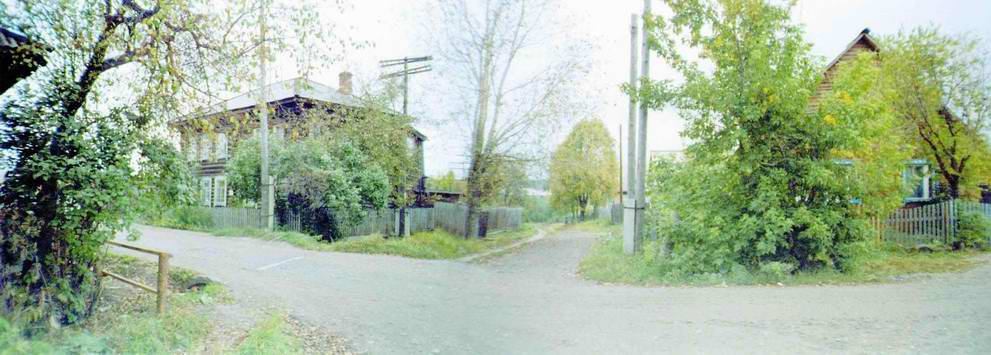
Vassily moved the family from Kursk to the new place which wasn’t very easy to travel to (the distance was 2400 km.), rented a couple of rooms in a two-storey house like shown below, quite typical in Siberian villages. 
Siberian Village Tugulym 

At the end of 1930, Tugulym was a small regional centre where there were a high school, a regional medical centre, a library and the so called ‘House of Culture’-a place where villagers watched performances and movies and organized meetings. Due to its location on the geographical border of Siberia, this village had an informal name, ‘The Gates to Siberia.’ During Tsarist times, large numbers of prisoners had to walk to serve the notorious penal servitude in Siberia. The road they took ran along the outskirts of Tugulym. 

The Prisoner's Road  to Siberia 
In April 1941, was born their second daughter Raissa and life for Vasily and his family appeared to have become stable till Hitler’s troops invaded Russia on the 22nd of June 1941 and the Second World War came upon our country. 

In early July, Vassily applied to the regional military recruitment office of the Soviet army and asked to be sent to the front urgently. Such actions were commonly initiated by millions of Soviet people; they were conscious of the need to defend their motherland and the responsibility and honour to do so. 

In October 1941, after a short training in a course for commanders, Vassily was given the rank of a lieutenant and sent to the north-western front as a cavalry platoon commander. At the beginning of 1944 he was already promoted to the rank of a senior lieutenant with a new appointment - assistant for supplies of 563 mortar regiment in the reserve regiment of the chief command. 

Tatyana and her friend
The situation in all the fronts in 1941-1944 for the Red Army was quite dramatic and a lot of young persons in Soviet Union who just reached 18, were to be drafted into the army. This also directly affected my family. 


In 1942 Vassily’s eldest daughter Tatyana was sent on a short-term course for radio operators and commissioned for war; sadly in 1943 she died in a Nazi attack. In the photo taken a month before her coming to the war, Tatyana is at the right side with her best friend. 
Alexander in 1843
The next year 1943 Vassily’s first son Alexander was also recruited and initially sent for training as an aircraft mechanic in school and later to the front. Alexander fought in the war and was granted State awards. The pictures compare how he grew up in War. Those who served in the USSR Air Force during the Second World War were known as ‘Stalin’s hawks’.
Sergeant Major Alexander
In 2015, I called my uncle Alexander to congratulate him on the occasion of the 70th of Anniversary of the Great Victory.That year he reached 90. Talking to Alexander I suddenly became aware how young he was when the Second World War finished – only 20 years old! 

The life in the deep Siberian region wasn’t easy. Evdokia worked hard (10-11 hours a day) at a state farm and ran her household. She constantly thought and worried about her children and husband in the war. The second son Vladimir helped Evdokia in housework and took care of his small sister – Raissa. In 1943 Evdokia, sent Vassily a picture of their young 2 year-old daughter.
Evdokia and Raissa in 1943 and Raissa in 1950s
Dr. Raissa in the 70s


Later in the 60s, aunt Raissa graduated from Medical Academy and became a doctor. She was a radiologist in medicine of high caliber. 


In May 1944, Vassily was seriously wounded and after treatment relocated to the south-western front. 
In the hospital May 1944
Given his efficiency and adroitness, Vassily was made a captain in the ordnance corpsresponsible for supplies of soldiers and ammunition. He proved to be excellent in his job and used every trick to keep his regiment contented with all the needs. He put his team to various jobs and that led to some remarkable results.[7]
Capt. Vassily in 1945

Sr. Lt. Vassily in 1943
Using the archival sources, I was able to discover episodes unknown to me that demonstrated the talents of Vassily for understanding and assessing people: “...In August 21-27/1944 Vassily K. organized perfectly uninterrupted supply of the regiment with ammunition, armament and food in spite of limited logistic capacities and in conditions of rapid advancement in battle. His actions strengthened combat capabilities for destruction of a Nazi grouping” - written in the “Award list” which I found at the site. For those acts of bravery, Vassily was awarded by the Order of Great Patriotic War of the 2nd grade. It was evident that he was able to get together a cohesive team, using his experience, knowledge and understanding of people. 

To complete the story of my Granddad in the World War, here are pictures of Vassily with his fellow soldiers and the image of the Order. 

With fellow soldiers
North western Front -winter 1943

Order of Great Patriotic War
Returning in December 1945, Vasilly constructed a comfortable home for the family. 


The battles were over and for the family, three of six members had participated in the Great Patriotic War; the elder daughter Tatyana perished while the others returned safety. For Russia it was just one from millions’ ‘payments’ towards the Great Victory. 


My father Vladimir also chose to join the armed service. In 1947 after graduating from high school in Tugulym, he was sent to the Naval Aviation College where he obtained the qualification of an Air Force mechanic like his brother Alexander. 

Young  Sergeant Vladimir 
My parents
Soviet Union started the next stage of restructuring staff in the armed forces. The veterans were being replaced by young generation. For the next seven years, Vladimir served in Polar Navy Air Forces near Murmansk city. As the member of crew, he flew in hydroplanes for patrolling the Russian sector of Arctic. During the voyages he visited plenty of Polar islands some of which were uninhabited. After demobilizing in early 50s Vladimir married, my mother whom he knew from his childhood. 
On the Polar Island

Being a small village, Tugulym had a major disadvantage. It lacked any facilities for higher education. That was why Vassily’s elder son Alexander at the end of 1940s moved to the administrative centre Sverdlovsk (nowadays - Ekaterinburg) and graduated from Ural Polytechnic Academy. He got a Diploma in Electrical Engineering and after some time became an assistant professor at the Academy. 

Vladimir with the support Alexander also moved to Sverdlovsk, where he was appointed in a factory which manufactured high-tech equipment for space flights. Starting his career as locksmith he reached the level of production site manager. 

After retiring my Granddad Vassily continued to be very active and engaged in beekeeping, remodeling of his estate and overseeing livestock. 

In the middle of the 60s the local administration of Tugulym offered Vassily the job of a carpenter to supervise the construction of a new local canteen for 200 visitors. It was a remarkable event because the village really needed a canteen and the local newspaper published a special report and published a picture of the veterans who participated in construction. 

The Veterans
All the men in the photograph were local heroes who experienced two Revolutions, the Civil war, the dramatic Stalin’s period, the World War, time of experiments with agriculture undertaken by Nikita Khrushev and a period of Brezhnev’s stagnation. They survived in spite of all the challenges and were yet ready to improve the quality of life in a small village Tugulym, the real rural Russia!

I am happy and proud that I got to spend my childhood in Tugulym in my grandparents’ home which I remember very fondly. There I got some lessons like: how to care for livestock and bees (Granddad Vassily was a passionate beekeeper) and to harvest hay, where in the nearest forest could mushrooms or wild berries be found, how to handle a hammer saw, axe and other carpentry tools. From my childhood I have learnt of other “rural” knowledge which may appear a bit exotic in our digital and postindustrial times. 

My fate, however, decreed that after high school I serve in the Soviet Army and later graduated from Mining Academy and due to the changes in Russia tried various jobs that took me to different countries in Africa, Middle East and South Asia. 

My Granddad Vasssily and my Grandmother Evdokia died in their home and are buried in the Tugulym cemetery. My parents Vladimir and Eugenia, aunt Raissa and Uncle Alexander  have also passed on. 

Looking at the photos of my heroes, I think: are these not the icons of the beginning of the 20th century? Are their lives not comparable to all the well-known historical figures? Nowadays I am trying to emulate their approach to life, their readiness to respond to challenges and their major characteristic, to take care of family in any changes and conditions of time. All this I hope to pass down to my descendants. 


Sergei K. lives in Moscow 


[1] Mongol Tartar empire established in the 13th century and gradually declined after the middle of the 14th century 

[2] Donald J. Raleigh, “Revolution on the Volga: 1917 in Saratov” (Cornell University Press, 1986). 

[3] Alexander Rabinowitch, “The Bolsheviks Come to Power: The Revolution of 1917 in Petrograd” (New York Norton, 1976). 

[4] A territory in Central Russia 

[5] Krepostnye krestyane or serfs comprising a large part of Russian peasants, they were actually slaves. It is hard to imagine now but until 1861 (the year of slavery was abolished in Tsarists Russia) the owners of serfs had the power to sell them (even separating from the other members of family), often in exchange for horses and carriages or to use as bails in financial transactions and as card debts. Russian serfs were regarded as property. The ‘state peasants’ had a different status and belonged to the Crown. Sometimes they could be transferred to the property of one of Tsar’s favorite landlords and become “krepostnye krestyane”. Fortunately, neither Vassily’s nor Evdokia’s families were ever serfs. Slavery was a big shame for Russian Empire and it was the major cause why peasants (accounted over 80% of the population in Russia) actively participated in the both of Revolutions during 1917. Their memory of slavery was still fresh! 

[6] Eastern Ukraine 

[7] I’d like to express my gratitude to the Russian Defense Ministry for their great job in digitalizing the files related to participation of Soviet citizens in the Second World War. Nowadays anyone can visit the site: http://podvignaroda.mil.ru/?#tab=navPeople_search and find information about their relatives who participated in the battles.